
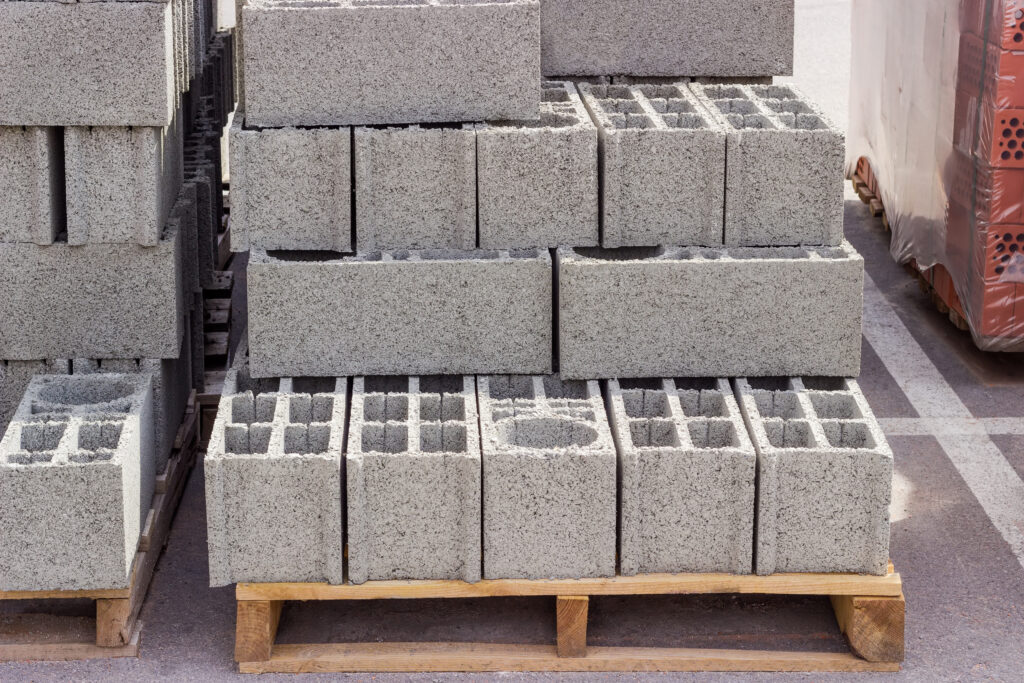
The Advantages of Lightweight Concrete Masonry Units (LWT CMU)
This is typically achieved by using lightweight aggregates such as expanded clay or shale. ASTM C90 classifies a lightweight block as any block with an oven-dry density of 105 pounds per cubic foot or less.
High-performing lightweight aggregates (LWAs) like expanded shales and clays are essential for producing lightweight concrete masonry units (LWT CMU). A typical LWT CMU weighs 30-40 percent less than normal weight (NWT) CMU and adheres to ASTM C90 standards.
How Much Does a Lightweight Block Actually Weigh Compared To a Traditional Block?
ASTM C90 classifies lightweight blocks as having a density of 105 pounds per cubic foot. For a typical 8x8x16 unit, this translates to about 28 pounds per block. Lightweight blocks can go much lighter, with some weighing as low as 18 pounds per block.
Note: a traditional block generally weighs about 35 pounds per cubic foot, making it significantly heavier.
Both Arcosa and Stalite Lightweight’s expanded shale and clay aggregates not only reduce weight but also provide benefits at all stages of design, construction, and operation due to their structural strength, durability, inertness, and lightweight properties. These aggregates are created by expanding selected raw shale or clay minerals in a rotary kiln at temperatures over 2000°F.
Enhanced Fire Resistance of Lightweight Masonry Blocks
All CMU have good fire resistance ratings, with LWT CMU performing better due to the insulating properties of the trapped air bubbles in the LWAs. Consequently, less concrete is needed to achieve equivalent fire resistance ratings compared to normal weight CMU.
LWT CMU can achieve two, three, and four-hour fire ratings economically based on the minimum equivalent thickness required by building codes. Additionally, more LWT CMU can be stacked on a single pallet, reducing transportation requirements and environmental impact.
SmartWall LWT CMU – Improved Strength and Reduced Weight
According to ASTM C90, standard LWT CMU must have a minimum compressive strength of 2,000 psi with a concrete density no more than 105 pcf. SmartWall units exceed these density and strength requirements, having a density of 93 pcf and a compressive strength of 2500 psi, achieved through optimized gradation of Arcosa Lightweight aggregates combined with regular aggregates.
Higher strength allows for designing efficient load-bearing structures, and lighter units improve mason productivity, potentially reducing construction timeframes.
Is Lightweight Block Easier To Use Than Traditional Block?
Yes, lighter weight means increased productivity for masons, as they can place more units per day.
This not only speeds up construction but also improves health and ease for the masons working on the project.
Energy Code Compliance with LWT CMU in Cold Climates
Insulated LWT CMU offer R-values 2-3 times higher than identical NWT CMU, aiding in energy code compliance. COMCheck software is recommended for determining energy code compliance for commercial buildings.
Whole-building computer modeling studies indicate that LWT CMU, including traditional 3-web and newer 2-web units, perform well across all eight climate zones, particularly in schools, supermarkets, and retail stores.
What are the thermal properties of lightweight block?
Thermal resistance varies based on unit shape, size, density, and materials used. Factors like web and face shell dimensions are critical.
For example, a standard heavyweight 8” block has an R value of 1.99, which can increase to 4.02 when cores are filled with foam insulation. Reducing web configuration and using lightweight aggregate raises the R value to 2.3, and up to 9.39 when filled with foam insulation.
Safety and Efficiency Benefits of LWT CMU for Masons
Using LWT CMU benefits masons and subcontractors by speeding up wall construction and reducing job site injuries due to their lighter weight. This reduction in injuries lowers Worker Compensation Claims and insurance premiums, ultimately reducing wall costs for building owners.
In many U.S. regions, increased mason productivity offsets the higher cost of LWT CMU. Since project owners pay for a finished wall, if the cost is comparable or less with LWT CMU, it presents a viable option for contractors aiming to deliver high-quality projects efficiently while preserving worker health.
For more information on Lightweight Aggregate (LWT) and case studies, reach out to our members: